Texas Small Businesses Are Losing 40% of Their Market by Having English-Only Websites
2026-06-29 · 7 min read · EWNexus Editorial
Texas has 5.9 million Spanish-speaking residents. In Houston, 43% of the population speaks Spanish at home. In San Antonio, it's over 55%. In the Dallas-Fort Worth metroplex, Spanish is the primary language for 27% of residents.
For local service businesses — HVAC, auto repair, restaurants, salons, towing, construction — these aren't demographic statistics. They're customers who are searching for your services right now, finding your English-only website, and calling your competitor who has a Spanish-language option.
The Search Behavior Gap
When a Spanish-speaking homeowner's AC goes out in July, they search. The exact terms they use and the results they click depend entirely on which language feels more natural.
Google's own research on Hispanic digital behavior shows:
- 72% of U.S. Hispanic consumers prefer content in Spanish when available
- Spanish-language searches for local services have grown at 2× the rate of English-language local searches over the past three years
- Mobile searches in Spanish for "near me" service queries have higher intent-to-contact rates than English equivalents (the searcher is ready to call)
A business that appears in Spanish-language search results reaches a customer who has already filtered for language accessibility. That's a pre-qualified, high-intent lead — and most local competitors aren't competing for it.
Why Most Businesses Don't Have It
The three most common reasons local Texas businesses don't have a Spanish-language website:
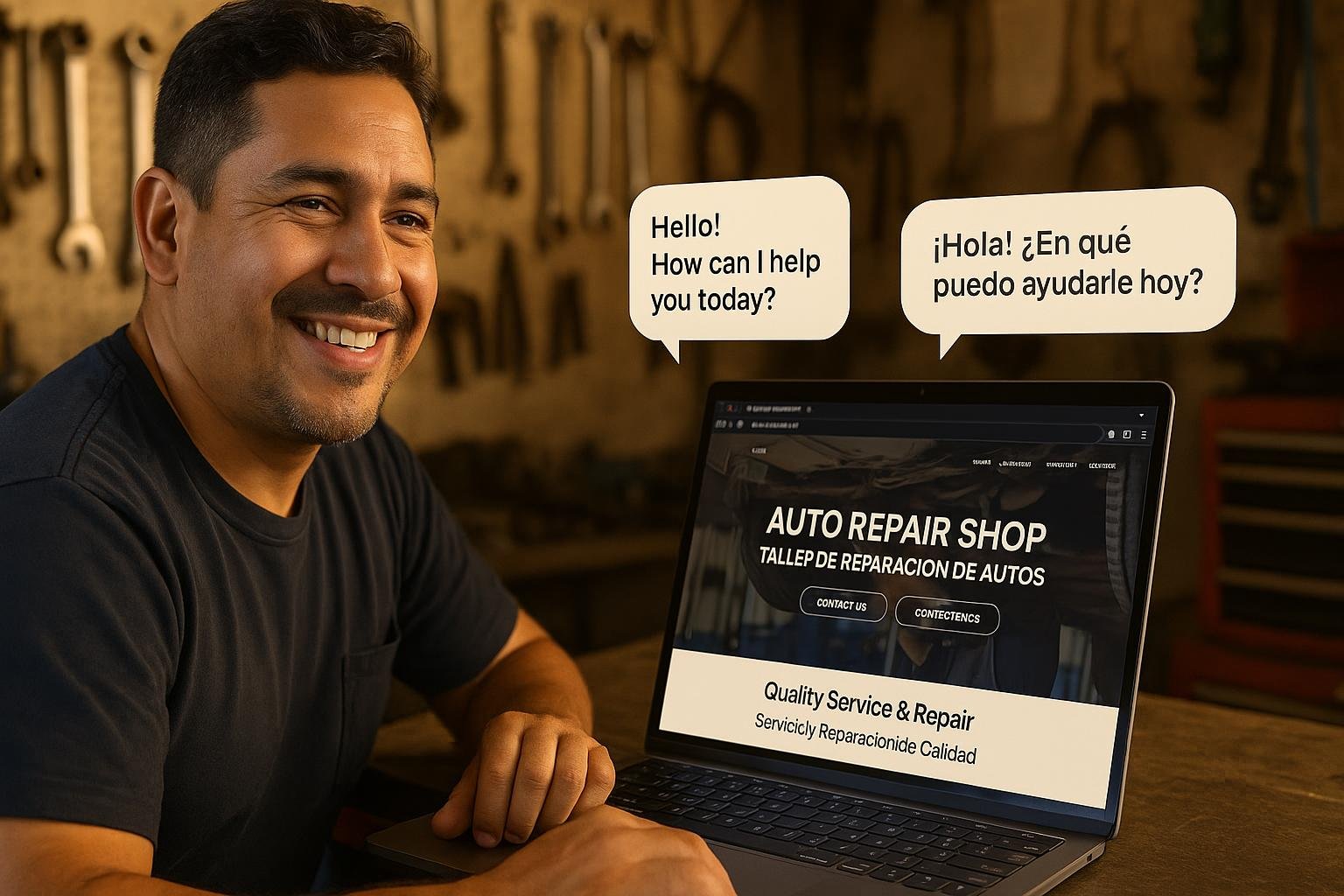
"Our staff doesn't speak Spanish." Website translation and phone/in-person service language are separate issues. A bilingual website sends a signal of accessibility — even if the first call goes to an English speaker with a translation app. The point is capturing the lead, not achieving perfect bilingual operation from day one.
"Translation tools are good enough." Auto-translated websites (Google Translate applied to existing content) read as obviously machine-generated to native speakers. Common problems: incorrect regional idioms, literal translations that change meaning, and formatting that breaks on the translated version. A Spanish-speaking customer who reaches a poorly auto-translated site often perceives it as less trustworthy than no translation at all.
"I don't know how to maintain two versions." This is the most legitimate concern — and it's why most attempts at bilingual websites fail. The solution is a site architecture that makes bilingual updates as simple as updating one version. A properly built bilingual site updates both languages from a single content entry.
What a Bilingual Website Looks Like in Practice
A functional bilingual website for a local Texas service business isn't a full translation of every page — it's strategic:
Homepage: Fully bilingual, with a prominent language toggle. The default language should be determined by the user's browser settings (most modern site frameworks support this automatically).
Services page: Key services described in both languages. Pricing transparency in Spanish reduces phone barriers — a Spanish-speaking customer who doesn't see prices in their language often doesn't call because they're uncertain about the interaction.
Contact/booking form: Bilingual form labels and error messages. A form that's half in Spanish and half in English signals incomplete effort and reduces completion rates.
FAQ: High-value content for SEO in Spanish. Spanish-language FAQ pages for local services rank with very low competition in most Texas markets — a 500-word Spanish FAQ about "how much does AC repair cost in Houston" faces almost no competition in Google's Spanish-language local results.
What you don't need to translate: Blog posts (unless specifically for the Spanish-language audience), privacy policies, terms of service. Focus resources on pages that affect the decision to contact you.
The SEO Opportunity
Here's the part most businesses miss: a properly built Spanish-language website section creates a separate SEO surface area that is dramatically less competitive than the English equivalent.
Example:
- English search: "HVAC repair Dallas" → Top 10 results include major national chains with 10+ years of SEO investment
- Spanish search: "reparación de HVAC Dallas" → Top 10 results are often thin local directory listings and a few Spanish-language results from major chains who bothered to translate
A local Dallas HVAC business with a quality Spanish-language service page, properly structured with local SEO elements (city name, neighborhood mentions, phone number in the local format), can rank in the top 3 for Spanish-language local HVAC terms within 3–4 months — because the competition hasn't bothered.
This is accessible competitive advantage. Most businesses won't take it.
The AI Customer Service Layer
A bilingual website captures the lead. The next friction point is the response.
If a Spanish-speaking customer fills out your contact form or initiates a chat conversation in Spanish, and the first reply they receive is in English (because that's what your staff responds in), the conversion rate drops significantly. The customer perceives a mismatch between the website's promise of accessibility and the actual service experience.
An AI customer service system that responds fluently in Spanish — answering common questions about services, pricing, and availability — bridges this gap without requiring bilingual human staff. The AI handles the initial qualification and scheduling; a human closes the work in whatever language is comfortable.
For Texas service businesses in competitive markets, this combination — bilingual website + bilingual AI response — creates a customer experience that Spanish-speaking residents actively seek out and refer to others.
What It Costs, What It Returns
A properly built bilingual website for a Texas local service business:
- EWNexus bilingual site: $600 one-time, includes Spanish and English versions, mobile-optimized, local SEO structure
- AI customer service add-on: $20–35/month, handles both English and Spanish inquiries 24/7
Return scenario (conservative, HVAC example):
- 3 additional Spanish-language inbound contacts per month (from improved search ranking + website accessibility)
- 50% conversion to job booking
- Average job value $400
- Monthly revenue from Spanish-language traffic: $600
- Annual: $7,200
- Cost of bilingual website: $600 one-time + $420/year for AI service
- Net first-year gain: $6,180
The math works for any service business with average job values above $150 — which is every service category we work with.
How to Get Started
EWNexus builds bilingual (English + Spanish) small business websites for Texas service businesses. The site is live in 10–14 business days, includes local SEO optimization in both languages, and requires no ongoing maintenance fees.
Contact us for a bilingual site demo — we'll show you what your site could look like in Spanish before you commit to anything.
Frequently Asked Questions
Does a Spanish-language website section actually rank in Google for Texas local searches?
Yes—and with far less competition than English. Example: English search "HVAC repair Dallas" competes against national chains with 10+ years of SEO investment. Spanish search "reparación de HVAC Dallas" typically shows thin local directory listings with minimal optimization. A local business with a quality Spanish-language service page can reach top-3 for Spanish local terms within 3–4 months in most Texas cities.
How much does a bilingual English-Spanish website cost from EWNexus?
EWNexus builds bilingual websites for Texas service businesses at $600 one-time. This includes both English and Spanish versions, mobile optimization, local SEO structure in both languages, a contact form, and 3 rounds of revisions. AI customer service (bilingual chat + missed call text-back) starts at $20/month as an add-on.
Can EWNexus build a bilingual website if the business owner doesn't speak English?
Yes. EWNexus handles all English content creation—you provide your services, pricing, and business information in Spanish, and we handle the English version. The entire project communication can happen in Spanish. This is a common setup for Hispanic-owned service businesses in Houston, Dallas, and San Antonio.
Ready to grow your business with a professional website? Talk to us on WhatsApp — It's free →
Related Articles
Sources & References
Get a Free Website Audit for Your Texas Business
Bilingual capability. Local SEO. Ready in 2 weeks.
FREE WEBSITE AUDIT →